Is Dental Considered Medical? Understanding Coverage & Classification | iCore
Dental and medical coverage aren't the same — but the line is blurring. Learn when dental becomes medical, how cross-billing works, and how iCore helps practices capture every reimbursement they're owed.
iCoreConnect
Published by iCore | Updated May 2026 | 8 min read
If you've ever sat in a dentist's chair and wondered, "Why isn't this covered by my health insurance?" — you're not alone. It's one of the most common and genuinely frustrating questions patients ask. And honestly, the answer isn't as simple as yes or no.
Let's break it all down — the coverage rules, the insurance classifications, how the law treats dental care, and why the line between dental and medical is blurring faster than ever.
So, Is Dental Considered Medical?
The short answer: not by default — but it's complicated.
In the United States, dental care and medical care have historically been treated as two completely separate systems. You have your health insurance for your body, and dental insurance for your teeth. Different cards, different deductibles, different networks. It's a divide that was baked into the system decades ago and has persisted ever since.
But here's the thing — your mouth is part of your body. And the science is increasingly making that case in ways insurers and policymakers can no longer ignore.
Why Are Dental and Medical Coverage Separate?
This is where it gets a bit historical. When employer-sponsored health insurance became widespread in the 1950s and 60s, dental care was considered a separate, elective category. Teeth weren't seen as integral to overall health — they were aesthetic, discretionary, a luxury even.
That thinking shaped decades of insurance design. Standard health plans were built around three pillars: doctor visits, hospital stays, and surgeries. Dental didn't fit neatly into any of them, so it got its own lane.
The result? Most Americans today carry two completely separate insurance products for what is, biologically speaking, one body.
What the ACA Says About Dental Coverage
The Affordable Care Act (ACA) did move the needle — but only partially.
Under the ACA, dental coverage is classified as an Essential Health Benefit (EHB) for children under 18, meaning plans must offer it. For adults, however, it's a different story. Adult dental care is not required to be included in standard health plans.
There's been movement on this front. HHS proposed removing the prohibition on classifying routine adult dental coverage as an EHB, which would give states the option to require it. But as of now, if you're an adult, your employer-sponsored plan almost certainly does not include dental unless it's explicitly stated.
The bottom line: dental is legally distinct from medical coverage for adults in most insurance contexts.
When Does Dental Become Medical? (The Gray Zone)
Here's where it gets genuinely interesting — and where the walls between dental and medical start to come down.
There are several scenarios where dental treatment crosses into medical territory and may be covered under your medical insurance:
Medically necessary oral surgery — Things like jaw reconstruction, removal of tumors, or treatment of oral infections that pose systemic risk can often be billed medically.
Accidents and injuries — If you break a tooth in a car accident, that's typically covered under medical, not dental.
Sleep apnea devices — Oral appliances used to treat sleep apnea are frequently covered under medical plans because sleep apnea is classified as a medical condition.
Pre-surgical dental clearance — Medicare now covers dental examinations before organ transplants, cardiac valve replacement, certain cancer treatments, and dialysis. This is a significant expansion that began in 2023 and has grown each year since.
Radiation-related dental care — Patients undergoing head and neck cancer treatment can receive Medicare-covered dental services related to their treatment and recovery.
This overlap is exactly why dental-to-medical cross-coding has become an important skill for dental practices. It's not about gaming the system — it's about accurately billing for services that genuinely fall under medical jurisdiction.
At iCore, we help dental practices navigate this complexity through our Medical Billing Coding solution, which is built specifically to identify cross-coding opportunities and ensure practices capture every dollar they're legitimately owed. |
The Oral-Systemic Health Connection: Why This Matters More Than Ever
Let's talk about the science, because it fundamentally changes the conversation about whether dental should be considered medical.
Research has established significant associations between oral health and systemic disease. Periodontal disease has been linked to cardiovascular disease, diabetes, stroke, respiratory illness, kidney disease, and adverse pregnancy outcomes. One comprehensive review found that individuals with periodontal disease are between 1.7 and 7.5 times more likely to develop certain systemic conditions.
The American Dental Association actively supports treatment to optimize oral health prior to organ transplants, joint replacements, and cardiac surgery — because the evidence of connection is that strong.
Think about it this way: if a patient with uncontrolled diabetes walks into a dental office, their oral health is directly affected — dry mouth, slower healing, higher cavity risk, greater susceptibility to gum disease. And the relationship goes both ways. Poor oral health can worsen glycemic control in diabetic patients.
The mouth isn't a separate system. It's a gateway. Treating it as financially and medically isolated from the rest of the body is increasingly at odds with what the clinical evidence shows.
How Dental Insurance Actually Classifies Services
Even within dental insurance itself, there's a classification system that determines how much gets covered:
Preventive Services (usually covered 80–100%) — Cleanings, exams, X-rays, fluoride treatments. These are the services insurers want you to use, because catching problems early costs everyone less in the long run.
Basic Services (usually covered 50–80%) — Fillings, simple extractions, periodontal treatment. These address problems that have developed but aren't yet severe.
Major Services (usually covered 50% or less) — Crowns, bridges, implants, root canals, surgical extractions. These are complex procedures, often costly, and where patients feel the out-of-pocket pain most acutely.
Most dental plans also come with an annual maximum — typically $1,000 to $2,000 — which can run out quickly when major work is needed. This is one of the most common sources of billing confusion and patient frustration.
The Medicare Dental Evolution
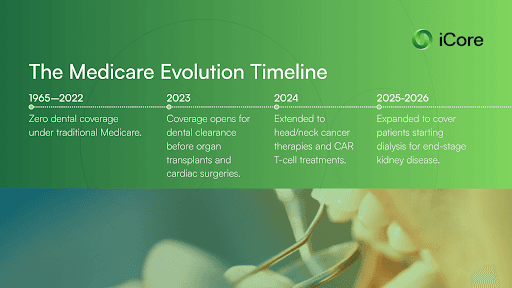
Medicare has been one of the most notable fronts of change. Since its creation in 1965, Medicare famously did not cover dental services. That began to change in 2023, when Medicare started covering dental services "inextricably linked" to specific covered medical procedures.
The expansion has grown year by year:
2023 — Dental clearance before organ transplants and cardiac surgery
2024 — Coverage extended to head and neck cancer patients, those receiving high-dose bone-modifying agents and CAR T-cell therapy
2025 — Extended to patients with end-stage kidney disease beginning dialysis
This is a meaningful shift. While it's still far from comprehensive dental coverage, it signals that the federal government is beginning to acknowledge what clinicians have long known: dental health and medical health are connected.
Dental Insurance vs. Medicare Dental Coverage
Feature | Standard Dental Insurance | Traditional Medicare (Parts A & B) |
|---|---|---|
Purpose | Separate product for routine/major services. | Limited; covers services "inextricably linked" to specific medical procedures. |
ACA Status | Required EHB for children (under 18); optional for adults. | Not applicable; Medicare is a separate program. |
Annual Maximum | Typically has an annual maximum ($1,000–$2,000). | No specific annual maximum for the few covered dental services. |
Example Coverage | Cleanings, fillings, crowns. | Pre-surgical dental clearance, certain cancer-related dental care, dialysis-related care. |
What This Means for Dental Practices
For dental practice administrators and dentists, the blurring line between dental and medical isn't just philosophically interesting — it has real revenue implications.
Many practices are leaving money on the table by not exploring medical billing for services that qualify. Procedures tied to sleep apnea, TMJ disorders, oral infections with systemic risk, and pre-surgical clearances may all be eligible for medical reimbursement — but only if the claim is coded and submitted correctly.
This is an area where the right technology and expertise make a measurable difference. iCore's Medical Billing Coding tool helps practices identify these cross-billing opportunities, apply the right ICD-10 and CPT codes, and submit claims that stand up to payer scrutiny. It's not about doing more work — it's about being paid fairly for the work already being done.
Beyond cross-coding, managing the full revenue cycle — from insurance verification to claim submission to patient billing — requires systems that can handle the nuances of both dental and medical billing environments. That's exactly what iCore's platform is built to do, giving practices a single connected workflow instead of a patchwork of disconnected tools.
A Note for Patients
If you're navigating this as a patient, here's practical advice:
Always ask your dentist's office whether a procedure might be eligible for medical billing. Many patients don't know to ask, and many front desk staff don't proactively check. The same procedure — say, a bone graft related to an implant — might be coverable under medical in certain clinical circumstances.
Keep your dentist informed about your medical history. The oral-systemic connection means your dental provider needs context about conditions like diabetes, heart disease, or cancer treatment to give you the best care — and to potentially help you access benefits you didn't know you had.
Don't let the insurance structure determine your care decisions. Coverage gaps are real, but so is the health consequence of delaying treatment.
The Future: Will Dental and Medical Merge?
More and more health policy experts, dental organizations, and patient advocates are pushing for integrated dental-medical coverage. The argument is straightforward: you cannot have whole-body health without oral health.
Some Medicaid programs have expanded adult dental benefits. Some Medicare Advantage plans offer supplemental dental coverage. Employer plans are slowly evolving. The direction of travel is toward integration — but we're not there yet.
For dental practices, the smartest move right now is to operate at the intersection: understand both billing systems, capture every legitimate reimbursement opportunity, and invest in technology that makes that possible.
FAQ
Q: Is dental insurance the same as medical insurance? No. Dental and medical insurance are separate products in the U.S. They have different networks, deductibles, and coverage rules. Standard health insurance plans do not include dental coverage for adults unless specifically stated.
Q: Can dental work be covered by medical insurance? Yes, in certain situations. Procedures medically necessary due to accidents, sleep apnea devices, pre-surgical dental clearances, oral infections with systemic implications, and certain cancer-related dental care may be covered under medical insurance. Proper cross-coding is required.
Q: Is dental considered an essential health benefit under the ACA? Dental is an essential health benefit for children under 18 under the ACA. For adults, it is not required to be included in standard marketplace or employer plans.
Q: Does Medicare cover dental? Traditional Medicare (Parts A and B) has very limited dental coverage. Starting in 2023, Medicare began covering dental services inextricably linked to specific medical procedures, including pre-surgical clearances for organ transplants, cancer treatment, and most recently, dialysis patients.
Q: What is dental-to-medical cross-coding? Cross-coding is the practice of billing certain dental procedures to a patient's medical insurance rather than (or in addition to) dental insurance, when the service meets medical necessity criteria. It requires using ICD-10 and CPT codes alongside standard CDT codes. iCore's Medical Billing Coding solution helps dental practices identify and submit these claims accurately.
Q: Why does oral health affect overall body health? Research has linked periodontal disease to cardiovascular disease, diabetes, stroke, respiratory illness, and other systemic conditions. The mouth is a point of entry for bacteria and inflammation that can affect the rest of the body, making oral health an integral part of overall health — not a separate concern.
Q: How can iCore help dental practices with dental-medical billing? iCore offers a Medical Billing Coding solution that helps dental practices identify cross-billing opportunities, apply correct medical codes, and submit claims to medical payers. Combined with iCore's broader revenue cycle management platform — including insurance verification, dental insurance billing, and patient billing — practices can manage both dental and medical revenue streams in one connected system.
At iCore, we believe dental practices deserve tools as sophisticated as the care they deliver. From insurance verification to medical billing coding to patient payments, our platform is built to simplify the complexity — so your team can focus on patients, not paperwork. Learn more at icoreconnect.com
Other articles

Dental Claims & RCM
Learn how to process dental insurance claims faster, reduce denials, and get paid consistently with this step-by-step guide from iCore.

Dental Claims & RCM
Learn what features matter most in dental medical billing software and how iCore helps dental practices reduce denials and recover more revenue.
Dental Claims & RCM
Dental and medical coverage aren't the same — but the line is blurring. Learn when dental becomes medical, how cross-billing works, and how iCore helps practices capture every reimbursement they're owed.

Dental Claims & RCM
Learn how dental billing management systems improve internal workflows, reduce claim delays, and increase practice efficiency. Discover how iCore helps practices streamline operations.
Dental Claims & RCM
Learn when dental practices should hire billing experts and how iCore helps reduce claim denials, improve cash flow, and streamline revenue cycle management.

Dental Claims & RCM
Learn the most important dental billing laws every practice should understand. Discover compliance tips, real examples, and how iCore helps reduce claim denials and billing risks.