Step-by-Step Guide to Dental Insurance Claims Processing | iCore
Learn how to process dental insurance claims faster, reduce denials, and get paid consistently with this step-by-step guide from iCore.
iCoreConnect

Published by iCore | Updated June 2026 | 11 min read
Let's be real for a second.
If you ask most dental practice owners what keeps them up at night, it is rarely the clinical side of things. They have trained for years for that. What actually causes stress (the kind that follows you home) is the billing. The claims that bounce back for reasons that make no sense. The payments that take three weeks when they should take three days. The front desk coordinator who spent her entire Tuesday morning on hold with a payer trying to get a status update on a claim that should have been straightforward.
Sounds familiar?
Here is what we have learned working with thousands of dental practices across the country: the difference between a practice that gets paid quickly and consistently and one that is perpetually chasing old claims almost always comes down to process. Not luck. Not the size of the practice. Not even which payers they work with. Process.
And process is something you can fix.
This guide walks through every step of dental insurance claims processing — what to do, when to do it, and what typically goes wrong at each stage so you can stop the revenue leaks before they start.
Before We Dive In, Here Is What This Guide Covers
If you are short on time, here is the full picture in one place. Every one of these points is covered in detail below — but this gives you a quick reference you can return to anytime.
Step 1 — Verify Insurance Before the Patient Arrives, Not After
Step 2 — Get the Patient Information Right Every Single Time
Step 3 — Understand Pre-Authorization Before You Schedule the Procedure
Step 4 — Write Documentation That Tells the Clinical Story
Step 5 — Submit the Same Day, Electronically, Every Time
Step 6 — Track Claims After They Leave Your Office
Step 7 — Reconcile ERAs Every Day, Not Every Week
Step 8 — Treat Denial Management as a System, Not a Chore
Step 9 — Bill Patient Balances Within 48 Hours of Payment Posting
Step 10 — Review Your Numbers Every Month Without Fail
The Simple Truth About Getting Paid Faster
Frequently Asked Questions
Let's Look at What the Numbers Actually Say
Before getting into the how, it helps to understand the size of the problem.
According to recent industry data, dental insurance claims take anywhere from 15 to 60 days to process, and lengthy approval timelines alone are responsible for 30% of all delayed reimbursements in dental practices. That is a 45-day window of uncertainty sitting between completed treatment and actual revenue. DayDream
The average claim processing time across most PPO plans runs between 17 and 22 days — but more importantly, over 30% of dental claims are initially rejected due to missing or incorrect information. Joinkwikly
Nearly one in three claims. Not because the treatment was not covered. Not because the patient was ineligible. Because something preventable went wrong in the paperwork before the claim even left the building.
And with nearly 284 million Americans currently covered by some form of dental benefit, the volume of claims moving through the system every day is staggering — which means payers are not getting more lenient about incomplete submissions. They are getting stricter. nj
The practices that consistently get paid faster are not doing anything magical. They are just doing the basics well, every single time. Here is how.
Step 1 — Verify Insurance Before the Patient Arrives, Not After
This is the foundation everything else is built on. If you are verifying eligibility the morning of the appointment — or worse, at check-in while the patient is standing at your front desk — you are already behind.
Real insurance verification means knowing before the patient's appointment whether their coverage is active, what their specific benefits include, how much of their deductible and annual maximum has been used, and whether the procedure you are planning has any limitations, waiting periods, or pre-authorization requirements attached to it.
When that information is in hand before the appointment, your staff can have an honest financial conversation with the patient. Your treatment plan is accurate. Your claim is built on solid ground from the start.
When it is not — when someone is calling a payer at 8am on the day of the appointment and writing down benefits on a sticky note — the margin for error is enormous.
iCore's Verification of Benefits replaces that entire manual process with real-time automated eligibility checks across hundreds of payers. What used to take 15 to 20 minutes per patient takes seconds. Your team walks into every appointment prepared, not scrambling. And the downstream impact on claim accuracy is significant — because when eligibility information is right, a whole category of denials simply disappears.
Step 2 — Get the Patient Information Right Every Single Time
This one sounds almost too simple to include. But incorrect patient information is stubbornly one of the top reasons claims get rejected — and it happens in practices that absolutely know better.
A single transposed digit in a date of birth. A subscriber ID copied from last year's card that has since been updated. A patient listed under their nickname instead of their legal name. These errors do not feel significant when they happen. They feel very significant when a claim bounces back two weeks later and someone has to track down the correct information, resubmit, and hope the timely filing window has not quietly closed in the meantime.
Before every appointment, confirm the full legal name exactly as it appears on the insurance card, date of birth, subscriber ID and group number, relationship to the subscriber for dependent patients, and secondary insurance details where applicable. Make it a checklist. Make it non-negotiable. It takes three minutes and it eliminates an entire category of avoidable denials.
Step 3 — Understand Pre-Authorization Before You Schedule the Procedure
Few things are more frustrating than completing a procedure, submitting a clean claim, and then receiving a denial because prior authorization was required and was not obtained. The treatment is done. The patient is gone. The revenue that looked certain is now at risk.
The ADA draws a clear distinction between preauthorization — a formal approval required before performing certain procedures — and predetermination, which is a voluntary benefits estimate that helps with patient financial conversations but does not constitute a guarantee of payment or a procedural green light. Dental Claim Support
Procedures that commonly require pre-authorization include crowns, bridges, implants, bone grafts, orthodontics, and periodontal surgery. But here is the thing: the requirements are not consistent across payers or even across plans within the same payer. What does not require authorization with Delta Dental may require it with Cigna. A plan that did not require it last year may have updated its policy.
The only reliable solution is having a payer-specific reference document your team can check before scheduling major procedures. Not relying on memory. Not assuming it is the same as last time. Checking the document. Update it when you notice changes. It becomes some of the most valuable institutional knowledge in your practice.
Step 4 — Write Documentation That Tells the Clinical Story
Here is something worth saying plainly: when a payer reviews a dental claim, they are not just checking whether the codes are correct. They are looking at whether the documentation makes a convincing case for medical necessity.
A crown code on a claim form is just a code. A clinical narrative that explains the extent of the decay, why a filling was not a viable option, what the X-ray findings showed, and why the recommended treatment was the appropriate clinical response — that is a claim that is significantly harder to deny.
With CDT 2026 code updates including significant changes to existing procedure codes, practices that are still working from last year's code templates are creating unnecessary rejection risk on every claim that includes a revised or deleted code. ScienceDirect
Build a documentation review into your pre-submission workflow. Not a lengthy audit — just a quick check that the narrative is there, the supporting X-rays are attached, the dates are consistent, and the codes are current. Two minutes before submission versus 45 minutes dealing with a denial and resubmission. It is not a close comparison.
Step 5 — Submit the Same Day, Electronically, Every Time
Electronically submitted claims are processed significantly faster — sometimes within 7 to 14 days — compared to paper claims which can take 30 days or longer because of the manual handling and postal delays involved. Wisdom
If any part of your practice is still submitting paper claims to any payer, stop today. There is no scenario in which paper is the right choice. Electronic submission is faster, more accurate, produces immediate confirmation of receipt, and creates a clean audit trail for every claim you ever need to reference or appeal.
On timing — submit the same day as treatment wherever possible. Timely filing requirements vary by payer, but commercial plans can have windows as short as 60 days. That might sound like plenty of runway until a claim gets lost in a queue for six weeks and suddenly you are resubmitting under pressure. Build same-day submission into the routine and timely filing becomes a non-issue.
iCore's Dental Insurance Billing handles electronic submission and automatically monitors timely filing deadlines across payers. The system flags anything approaching a deadline before it becomes a problem — which means you catch it with time to act, not after the window has already closed.
Step 6 — Track Claims After They Leave Your Office
Submitting the claim is not the end of your responsibility. It is roughly the halfway point.
A claim sitting in a payer's processing queue is not money in your account. It is a pending receivable — and pending receivables need active management. Payers lose claims. Payers hold claims waiting for information they never formally requested. Payers process claims incorrectly. None of this gets resolved if you are not watching.
Follow up on every outstanding claim every 10 days. Check status through the payer portal or your clearinghouse. If something has been sitting for more than two weeks without a determination, follow up directly. Do not wait for a denial notice that may arrive dangerously close to a timely filing deadline with little time left to act.
The practices that do this consistently — that treat claims tracking as a daily discipline rather than a monthly catch-up — carry significantly less aged AR than those that wait for problems to announce themselves.
Step 7 — Reconcile ERAs Every Day, Not Every Week
When a payer sends payment, they send it with an Electronic Remittance Advice — a detailed breakdown of exactly how every claim in that payment batch was adjudicated. What was paid. What was adjusted contractually. What was reduced, and the specific reason code explaining why.
Most practices post payments. Fewer practices actually read the ERAs carefully. That gap is where underpayments live.
A payer applying the wrong fee schedule. A contractual adjustment that exceeds what your agreement actually specifies. A procedure that was partially paid when it should have been paid in full. These discrepancies are not always large on a per-claim basis — but they are consistent, they compound over time, and they are invisible unless someone is checking.
Reconcile ERAs every day. It takes less time than dealing with the cumulative revenue impact of missing the errors they contain.
Step 8 — Treat Denial Management as a System, Not a Chore
Every practice gets denials. The difference is whether you have a system that handles them efficiently or whether each one is treated as an individual crisis that disrupts whoever happens to have capacity that day.
A real denial management system starts with categorisation. Every denial gets logged by reason code — eligibility issues, coding errors, missing documentation, non-covered services, timely filing, coordination of benefits. After a month of consistent logging, patterns emerge. And patterns tell you which step upstream in your process is generating the problem, which is far more valuable than winning individual appeals.
Set a standard for appeal turnaround time — 5 to 10 business days from receiving the denial is realistic for most practices. The faster you respond, the higher your overturn rate. Denials that sit for a month get appealed with less supporting documentation and less institutional memory of what happened clinically.
Track your appeal overturn rate by payer over time. Some payers deny a meaningful percentage of first submissions knowing that many will not be appealed. Knowing your overturn rate with those payers gives you leverage — either in appeals or in contract renegotiation conversations.
iCore's Practice Analytics surfaces denial patterns by payer and reason code in a clean dashboard. Instead of discovering a systemic problem three months after it started, your team sees it emerging in real time and can address it at the process level before it becomes a serious revenue issue.
Step 9 — Bill Patient Balances Within 48 Hours of Payment Posting
Once insurance has adjudicated a claim, the patient responsibility balance needs to move from your system to the patient's awareness — quickly, clearly, and with a straightforward path to payment.
The longer a statement takes to reach a patient after their appointment, the more it feels like a surprise bill rather than an expected cost of their care. Surprise bills generate disputes. Disputed bills generate delays. Delays turn into aged AR that is genuinely harder to collect the longer it sits.
Aim to send patient statements within 48 hours of the insurance payment posting. Include a clear breakdown of what insurance paid, what the contractual adjustment was, and what the patient owes. Make the path to payment obvious — an online portal, a phone number, a payment plan option if the balance warrants it.
iCore's Patient Billing automates statement generation and sends systematic follow-up reminders that keep patient balances moving without requiring your front desk to manually track every open account across hundreds of patients.
Step 10 — Review Your Numbers Every Month Without Fail
All of these steps form a system. And systems need regular review to stay healthy — not just when something has already gone obviously wrong.
Once a month, sit down with five numbers: your claim denial rate, your average days to payment by payer, your total AR over 90 days, your patient collection rate, and your outstanding appeal count. Nothing more complicated than that to start.
According to NADP's 2025 Plan Design data, 73% of dental PPO enrollees now carry annual maximums of $1,500 or more — meaning patient out-of-pocket balances are larger than they have ever been, and collecting that revenue efficiently has a more direct impact on practice profitability than it did even five years ago. Dentalaiassist
If your denial rate is consistently above 10%, the problem is upstream — in eligibility verification, documentation, coding accuracy, or pre-authorization compliance. Individual appeals will not fix it. Tracing it to the root will.
iCore brings all of this together in one place — real-time eligibility verification, electronic claim submission, ERA reconciliation, patient billing, denial analytics, and practice performance reporting — all connected, all built specifically for dental practices, and all designed to be used by dental teams without needing a billing specialist on staff to interpret the data. Over 5,000 practices nationwide trust iCore to run a revenue cycle that works the same way on a busy Tuesday as it does on a quiet Thursday.
The Simple Truth About Getting Paid Faster
None of what is described in this guide is complicated in isolation. Verify eligibility early. Get patient information right. Submit clean claims the same day. Track them after they go out. Reconcile ERAs daily. Follow up on denials fast. Bill patient balances promptly. Review your numbers monthly.
The challenge is doing all of it consistently, every day, across every patient, without a process that makes it automatic.
That is where the right technology stops being a nice-to-have and starts being the difference between a practice that runs cleanly and one that is perpetually firefighting. iCore exists to be that technology — the connected backbone of a revenue cycle that does not depend on someone remembering to follow up.
If any part of your current claims process feels like it is running on memory and goodwill rather than systems and software, that is exactly the gap worth closing.
See how iCore works for your practice →
Frequently Asked Questions
Q: What is dental insurance claims processing?
It is the full workflow a dental practice uses to get paid for completed treatment — starting with insurance eligibility verification before the appointment and ending with patient payment for any remaining balance after insurance pays. Everything in between, including claim submission, tracking, payment posting, and denial management, is part of the claims processing cycle.
Q: How long does dental insurance claims processing take?
Most electronically submitted claims process within 7 to 30 days when they go out clean and complete. Paper claims, claims requiring pre-authorization, or claims missing documentation can take 30 to 60 days or longer. Practices using real-time eligibility tools and same-day electronic submission — like those using iCore — consistently land at the faster end of that range.
Q: What are the most common reasons dental claims are denied?
Incorrect or missing patient information, outdated CDT codes, missing clinical documentation, failure to obtain required pre-authorization, and missed timely filing deadlines. The majority of these are preventable with the right upstream process — which is exactly what a connected revenue cycle platform like iCore is built to support.
Q: What is the difference between pre-authorization and predetermination?
Pre-authorization is a formal approval a payer requires before certain procedures are performed — submitting a claim without it results in denial. Predetermination is a voluntary estimate of expected coverage that helps with patient financial conversations but does not obligate the payer to pay. The ADA outlines both clearly on their pre-authorizations resource page.
Q: How can a dental practice reduce its claim denial rate?
Consistent real-time eligibility verification, accurate and current CDT coding, complete clinical narratives, same-day electronic submission, and systematic 10-day follow-up on outstanding claims. iCore supports all of these steps in a single connected platform, which is why practices using iCore consistently outperform industry average denial rates.
Q: What is an ERA and why should practices reconcile them daily?
n Electronic Remittance Advice is the detailed payment explanation a payer sends alongside reimbursement. It shows exactly how each claim was adjudicated — what was paid, what was adjusted, and why. Daily ERA reconciliation is how practices catch underpayments and processing errors before they compound into a significant and largely invisible revenue problem.
Q: How does iCore support dental insurance claims processing?
iCore provides a complete, connected dental revenue cycle platform — real-time eligibility verification, electronic claim submission and tracking, ERA payment posting, patient billing with automated reminders, and practice analytics that surface denial patterns and performance trends by payer. More than 5,000 dental practices nationwide use iCore to reduce denials, accelerate reimbursements, and run a revenue cycle that does not depend on anyone's memory. Learn more at icoreconnect.com.
iCore is a healthcare software platform trusted by more than 5,000 dental practices nationwide. From insurance verification to patient collections, iCore connects every step of your claims process — so your team spends less time on paperwork and more time delivering the care patients came in for. Learn more at icoreconnect.com
Other articles
Dental Claims & RCM
Learn how to process dental insurance claims faster, reduce denials, and get paid consistently with this step-by-step guide from iCore.

Dental Claims & RCM
Learn what features matter most in dental medical billing software and how iCore helps dental practices reduce denials and recover more revenue.
Dental Claims & RCM
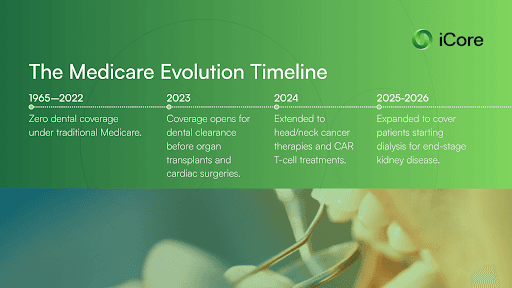
Dental and medical coverage aren't the same — but the line is blurring. Learn when dental becomes medical, how cross-billing works, and how iCore helps practices capture every reimbursement they're owed.

Dental Claims & RCM
Learn how dental billing management systems improve internal workflows, reduce claim delays, and increase practice efficiency. Discover how iCore helps practices streamline operations.
Dental Claims & RCM
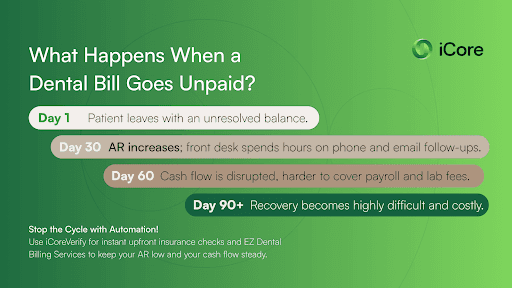
Learn when dental practices should hire billing experts and how iCore helps reduce claim denials, improve cash flow, and streamline revenue cycle management.

Dental Claims & RCM
Learn the most important dental billing laws every practice should understand. Discover compliance tips, real examples, and how iCore helps reduce claim denials and billing risks.