Dental Billing Laws Explained: Compliance Guide for Practices | iCore
Learn the most important dental billing laws every practice should understand. Discover compliance tips, real examples, and how iCore helps reduce claim denials and billing risks.
iCoreConnect

Introduction: One Small Billing Error Nearly Cost a Practice Thousands
Dr. Kevin Reynolds had spent over 15 years building a respected dental practice in Denver. Patients trusted him. His team was experienced. Revenue looked stable.
Then came an insurance audit.
At first, he wasn’t worried. But within weeks, the practice discovered multiple billing compliance issues:
Incorrect coding for procedures
Incomplete patient documentation
Claims submitted without proper verification
None of it was intentional.
Still, the consequences were serious:
Delayed reimbursements
Increased claim denials
Compliance warnings
Financial stress
That’s when Dr. Reynolds realized something many practices overlook:
Understanding dental billing laws is just as important as providing quality patient care.
To regain control, his practice partnered with iCore, a company specializing in dental billing and revenue cycle management solutions for U.S. dental practices.
Why Dental Billing Laws Matter More Than Ever
Dental billing laws exist to protect:
Patients
Insurance providers
Healthcare organizations
Dental practices themselves
Failure to comply can lead to:
Audits
Penalties
Revenue loss
Legal risks
According to the National Health Care Anti-Fraud Association, healthcare fraud costs the U.S. tens of billions of dollars annually, making compliance enforcement stricter than ever.
👉 https://www.nhcaa.org/tools-insights/about-health-care-fraud/
For dental practices, even accidental billing mistakes can trigger major issues.
The Most Important Dental Billing Laws Practices Should Understand
1. Accurate Coding Requirements
Data from 2026 confirms that government and private payor audits have risen sharply, specifically targeting "upcoding" and "unnecessary services".
Dental practices must use correct:
CDT codes
ICD-10 codes (when medically necessary)
CPT codes for medical billing situations
Incorrect coding can result in denied claims and compliance concerns.
Example:
Dr. Reynolds’ team mistakenly used outdated procedure codes for oral surgery claims.
Result: Multiple denials and delayed reimbursements.
How iCore Helped:
iCore implemented coding audits and verification systems that significantly improved billing accuracy.
👉 Learn more about dental coding standards:
https://www.ada.org/publications/cdt
2. Documentation Compliance Laws
Insurance claims must be supported by:
Clinical notes
X-rays or imaging
Treatment plans
Medical necessity documentation
Incomplete documentation is one of the leading causes of claim denials.
Auditors in 2026 are especially focused on high-risk areas where medical necessity links dental treatment to systemic health, such as pediatric pulpotomies and extractions required to eliminate infection before major surgery.
Example:
A sleep apnea appliance claim lacked detailed medical necessity documentation.
Result: Insurance rejection.
After iCore’s Support:
The practice adopted standardized documentation workflows, reducing errors and improving approval rates.
3. HIPAA & Patient Data Protection
Dental practices are legally required to protect patient information under HIPAA regulations.
Technically, HIPAA applies to “covered entities,” those that transmit health information electronically in connection with specific transactions. While this covers the vast majority of modern practices, a few very small, cash-only offices may have different requirements.
This includes:
Secure billing systems
Encrypted patient records
Controlled access to financial data
According to the U.S. Department of Health & Human Services, HIPAA violations can result in substantial financial penalties. Practices should be aware of the 2026 four-tier penalty structure defined by HHS. The penalties escalate based on the level of fault, ranging from an unknowing error to willful neglect:
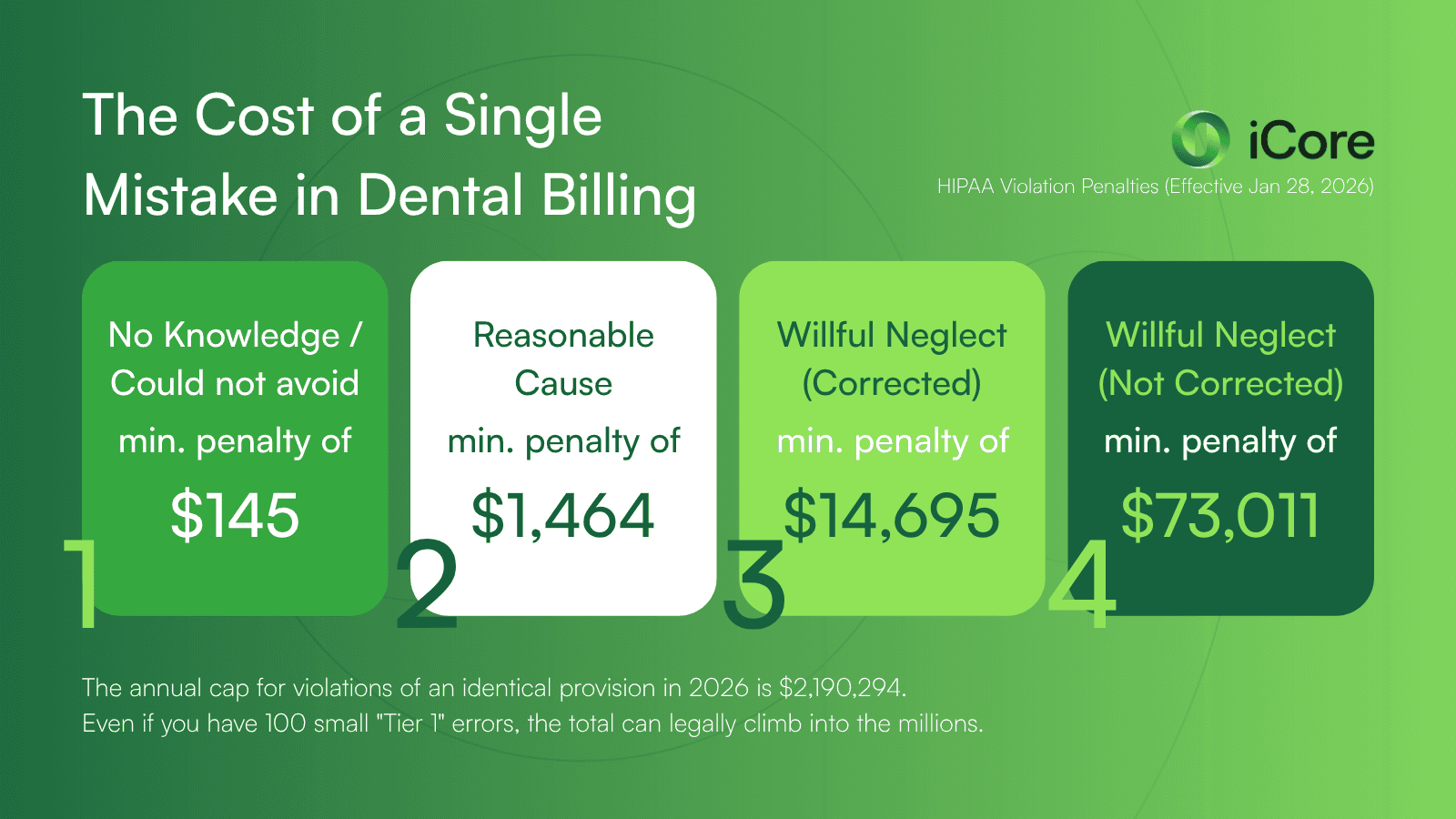
Tier 1: Lack of Knowledge/Unknowing
For violations the practice was unaware of and could not have reasonably known about. These carry the lowest minimum fines per violation.
Tier 2: Reasonable Cause
For violations due to reasonable cause, but not willful neglect. These carry higher minimum fines than Tier 1.
Tier 3: Willful Neglect (Corrected)
For violations resulting from willful neglect, but corrected within 30 days of discovery
Tier 4: Willful Neglect (Uncorrected)
For violations resulting from willful neglect that were not corrected within 30 days. These carry the highest minimum fines per violation.
While the penalty tiers set minimum and maximum costs per violation, the cumulative annual cap for violations of an identical provision, as of early 2026, is $2,190,294. This cap means that even 100 small Tier 1 (Unknowing) errors related to the same policy failure can legally climb into the millions, underscoring the severity of systemic non-compliance.
👉 https://www.hhs.gov/hipaa/index.html
With iCore, Dr. Reynolds’ practice improved compliance by implementing secure billing and documentation protocols.
4. Insurance Verification Requirements
Many billing problems begin before treatment even starts.
New 2026 CMS rules are transitioning electronic prior authorizations to a new FHIR-based standard, making automated verification systems even more critical for compliance.
FHIR (Fast Healthcare Interoperability Resources) is an industry-wide data standard that mandates how prior authorizations and eligibility checks are electronically exchanged. This regulatory requirement ensures seamless communication between providers and payers, making accurate, automated verification essential for preventing submission delays and denials in 2026.
Without proper insurance verification:
Claims may be submitted incorrectly
Coverage limitations can be missed
Patients may receive unexpected bills
Example:
A patient’s procedure required pre-authorization, but staff missed it during scheduling.
Result: Claim denied after treatment completion.
How iCore Solved It:
Automated insurance verification workflows reduced manual errors and improved pre-treatment accuracy.
Why Dental Practices Struggle With Billing Compliance
Dr. Reynolds discovered that most compliance issues came from:
Constantly changing insurance regulations
Manual administrative processes
Lack of staff training
Outdated billing systems
Modern dental practices need more than spreadsheets and manual tracking.
They need systems built for compliance and efficiency.
That’s where iCore delivers real value.
How iCore Helps Practices Stay Legally Compliant
iCore supports dental practices through:
Accurate coding assistance
Insurance verification automation and oversight
Documentation audits
HIPAA-conscious workflows
AI-driven billing oversight
Denial management support
This allows practices to:
Reduce compliance risks
Improve reimbursement speed
Protect revenue
Focus more on patient care
The Cost of Ignoring Billing Laws
Dr. Reynolds’ experience taught his team an important lesson:
Billing mistakes are not just administrative issues—they can become legal and financial liabilities.
Practices that fail to stay compliant risk:
Revenue leakage
Audits
Reputation damage
Operational disruptions
In today’s healthcare environment, proactive compliance is no longer optional.
Conclusion: Compliance Creates Stability
Dental billing laws may seem overwhelming, but the right systems and support can make compliance manageable.
By partnering with iCore, Dr. Reynolds transformed his practice from reactive and stressed to efficient and audit-ready.
Today, his team spends less time correcting claims—and more time delivering exceptional patient care.
Ready to Strengthen Your Dental Billing Compliance?
If your practice is struggling with claim denials, coding issues, or compliance concerns, now is the time to act.
iCore helps U.S. dental practices simplify billing, improve documentation accuracy, and stay compliant with evolving regulations.
👉 Contact iCore today for a FREE consultation and discover how smarter billing systems can protect your practice and improve profitability.
Other articles

Dental Claims & RCM
Learn how to process dental insurance claims faster, reduce denials, and get paid consistently with this step-by-step guide from iCore.

Dental Claims & RCM
Learn what features matter most in dental medical billing software and how iCore helps dental practices reduce denials and recover more revenue.
Dental Claims & RCM
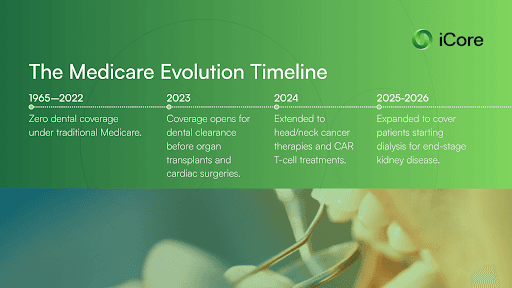
Dental and medical coverage aren't the same — but the line is blurring. Learn when dental becomes medical, how cross-billing works, and how iCore helps practices capture every reimbursement they're owed.

Dental Claims & RCM
Learn how dental billing management systems improve internal workflows, reduce claim delays, and increase practice efficiency. Discover how iCore helps practices streamline operations.
Dental Claims & RCM
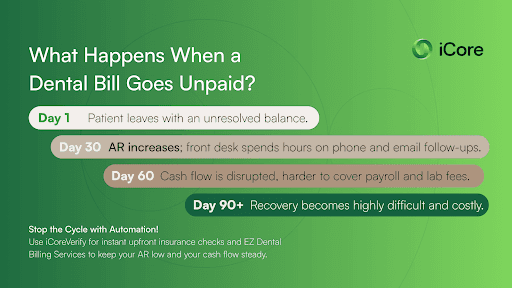
Learn when dental practices should hire billing experts and how iCore helps reduce claim denials, improve cash flow, and streamline revenue cycle management.
Dental Claims & RCM
Learn the most important dental billing laws every practice should understand. Discover compliance tips, real examples, and how iCore helps reduce claim denials and billing risks.